

Unexpected thoughts and emotions, shaped through a reporting journey far from the safety and noise of the capital. Would you live in a village in Western Lesvos?
Reporting journey: StoNisi.gr (text: Maria Chatzigeorgiou, photos: Panagiotis Balaskas)
With the support of: Heinrich Böll Foundation – Thessaloniki Office | As part of the programme: “Exploring the Rural – Urban Divide through Cooperative and Independent Media”

Two days in two villages. A journey through Western Lesvos. That was the framework. But something deeper was happening inside me. Because sometimes, you do not go towards a place, the place comes to you. It meets you. It reflects you back to yourself. It asks questions you do not know how to answer.
Distance from the capital, limited access to services, and economic uncertainty are part of everyday life for the residents. And yet, they persist. Livestock farmers, agricultural workers, and women from the agritourism cooperative bring life to their communities, while many young people are returning, because the village offers something rare in the countryside: work.
Mesotopos was the first stop. And what a stop. A village that feels alive, active, almost self-sufficient. I spoke with people who never left and never regretted it. I heard about dairies, cooperatives, agritourism, cultural associations, dance groups, football academies. And in their eyes, I saw a quiet, grounded happiness. Not superficial or staged, but deep. Rooted in everyday contact with the land, with others, with the community.
As I walked through the streets of Mesotopos, I felt something almost strange: envy. Or rather, a quiet longing. What would it be like to live here? To wake up with the sun, to work with your hands, to know all your neighbours by name, to live at a slower pace? For a moment, I felt that I wanted it. I really did.
But then doubt crept in. Me, someone who has built a life around the speed of work, proximity to infrastructure, the small “comforts” of the city, could I handle it? Maybe what I admire is beautiful to observe, but difficult to live. And yet, what if this distance, this separation from the “centre”, could open a different path for me? Toward a self more connected to what truly matters?
Somewhere in those village streets, I remembered my own. Because I, too, grew up in a village. I went to school there, played in open fields, dreamed under trees, not concrete. Until I was eighteen, I was also a child of the countryside. And for a moment I wondered: what would have happened if I had never left? Or if I went back now?
The thought lingered. As such questions always do, questions that do not need immediate answers.
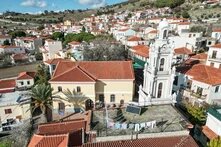
Mesotopos village in Western Lesvos, 12 December 2024.
Image credits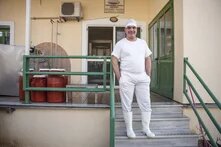
Giorgos Vasilas in front of his dairy in Mesotopos, Lesvos, 12 December 2024.
Image credits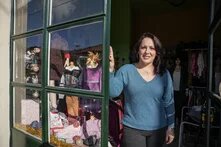
Athina Pipini in her shop in Mesotopos, Lesvos, 12 December 2024.
Image credits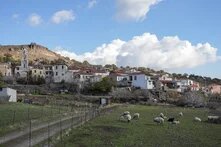
Mesotopos village in Western Lesvos, 12 December 2024.
Image credits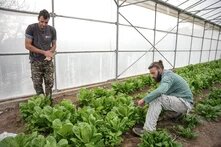
The Kaxyris brothers working in their greenhouse in Mesotopos, Lesvos, 12 December 2024.
Image credits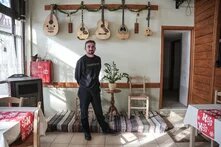
Gavriil Vougioukas in front of his collection of handmade instruments in his shop, Mesotopos, Lesvos, 12 December 2024.
Image credits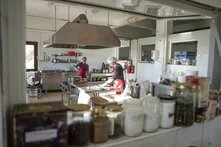
Women working at the Mesotopos women’s cooperative, 12 December 2024.
Image credits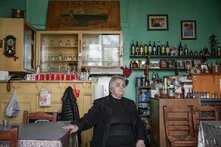
Maria Leontiou at her café in Antissa, Lesvos, 13 December 2024.
Image credits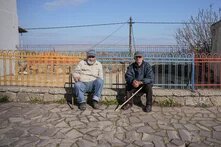
Residents of Antissa village in Western Lesvos, 13 December 2024.
Image credits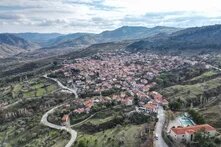
Antissa village in Western Lesvos, 13 December 2024.
Image credits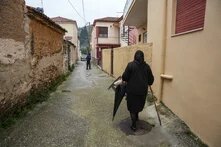
Residents of Palaiokipos village in central Lesvos, 14 January 2025.
Image credits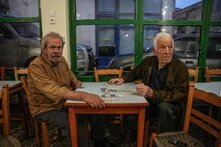
Residents of Palaiokipos village in central Lesvos, 14 January 2025.
Image credits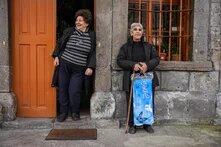
Residents of Pelopi village in northern Lesvos, 27 January 2025.
Image credits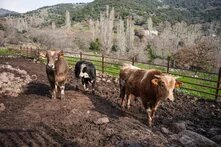
Livestock production in Pelopi village, northern Lesvos, 27 January 2025.
Image credits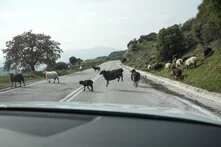
A flock of sheep on the road to Pelopi village, northern Lesvos, 27 January 2025.
Image credits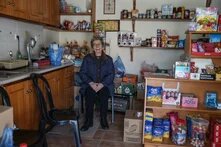
Mrs Maria in her shop in Chydira, Western Lesvos, 6 March 2025.
Image creditsThe second day found me in Antissa. A beautiful village, but more tired. Quieter, more wounded. There, I felt the weight of time. I saw it in Mrs Maria’s eyes at the café, as she spoke and cried about the village emptying out. That cry stayed with me. It was not just emotion, it was grief. Not for something that has ended, but for something slowly dying. And you feel helpless in front of it.
And yet, even in Antissa, there was hope. I saw it in the face of Vagia, the president of the cooperative, who fights every day, along with a handful of other women, to keep local production alive. I saw it in young Maria, raising her child on her own, having consciously chosen to stay. I saw it in the doctor who left his practice in Piraeus and moved to the village with his family. In Theologos, who turned his back on Athens because he was “tired of living inside the metro and buses”.
Human stories. Stories that change how you see the world. Because choosing the countryside is not easy. It takes persistence. It takes roots. It takes vision. And perhaps a touch of romanticism.
On the road back, a few thoughts brought both melancholy and glimpses of hope. Antissa and Mesotopos are not just two villages in Lesvos. They are living communities where love for place, hard work, and collective spirit turn difficulties into creation. Their residents insist on building their future there, investing in culture, production, and solidarity.
And yet, the survival of these villages is not guaranteed. Distance from urban centres, gaps in infrastructure, and uncertainty about the future are challenges that require support. For the countryside to remain viable, it needs stronger local economies, better services, and meaningful opportunities for young people.
When I returned from this two-day journey, I felt a mix of emotions. Admiration for what I saw in Mesotopos, sadness for what risks being lost in Antissa. Relief to be back “home”, but also a bittersweet thought that perhaps we are losing something valuable by living far from all this. And perhaps that value is not just nature, or pace, or “quality of life”, but people. Bonds. A sense of belonging.
Antissa and Mesotopos are mirrors. They show us what the Greek countryside once was, what it can still be, and what it may never become again. They remind us that life is not only the choices we make, but also the ones we never make.
And somewhere inside me, the question remains open: if I went back, could I endure it? Or rather, if I stayed, would I flourish?